|
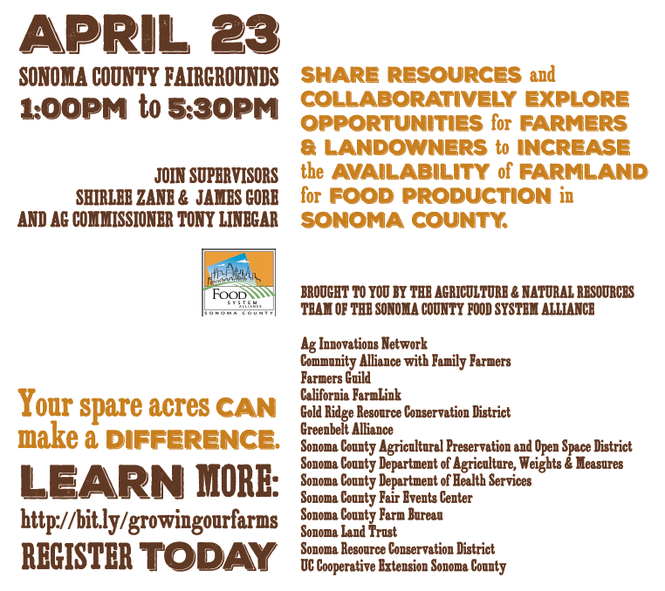
On April 23rd, over 150 farmers, land-owners and local food advocates gathered in Santa Rosa, CA to collectively ask: how can we connect more new farmers with land to grow our food? On this page you can explore ideas from that day, find land access resources, and watch our new video. Get in touch to learn how you can stay involved
|
RESOURCES
|
Organizations:
Ag Innovations Network; Dan Schurman, [email protected] American Ag Credit; Bill Rodda, [email protected] Community Alliance with Family Farmers, North Coast Chapter; Wendy Krupnick, [email protected] California FarmLink; Frederick Smith, [email protected] California Human Development; Marian Parsons, [email protected]! Gold Ridge Resource Conservation District; Brittany Heck, [email protected] Greenbelt Alliance; Teri Shore, [email protected] Permit Resource and Management Department; Traci Tesconi, [email protected]! Sonoma County Agricultural Preservation and Open Space District; Misti Arias, [email protected] Sonoma County Department of Agriculture, Weights and Measures; Tony Linegar, [email protected] Sonoma County Department of Health Services; Leah Murphy, [email protected] Sonoma County Farm Bureau; Tim Tesconi, [email protected]! Sonoma Land Trust; Amy Chesnut, [email protected].! Sonoma Resource Conservation District; Kara Heckert, [email protected]! The Farmers Guild; Evan Wiig, [email protected]! UCCE Sonoma County; Stephanie Larson, Ph.D, [email protected]; Linda Peterson, [email protected]! |
Farmland preservation:
Farmland conservation for climate protection, smart growth & food security: http://calclimateag.org/triple-harvest/ Farmland for Farming the pie ranch access to land project: http://aginnovations.org/images/uploads/FarmlandforFarming-1.pdf CA Ag Vision: Strategies for Sustainability: http://aginnovations.org/images/uploads/Ag_Vision_Final_Report_Dec_2010.pdf Nine Case studies of land trust working with next generation farmers: http://www.californiafarmlink.org/storage/documents/jobs/Land_Trust_Case_Studies_March2015.pdf! The County Land for Food Production Phase 2 (includes farming & grazing) report is on-line: http://ucanr.edu/sites/BFRSOCO/Land_Opportunities/ The Last Crop Trailer is a 3 minute video about saving farmland: http://thelastcropfilm.com/videomedia/ Financing: Conservation Financing for Farm Transfer: http://womencaringfortheland.org/wp-content/uploads/2013/11/conservation_financing.pdf Affording our Land; a Financial Literacy Guidebook for Young Farmers (and all farmers): http://www.thegreenhorns.net/guidebooks/affording-ourland-greenhorns-guide-to-financialliteracy/ Regulations: Ag Innovations: Regulating for Agricultural & Public Outcomes: http://aginnovations.org/images/uploads/Regulations_ag-public.pdf! Farmworker Housing: California Human Development: http://www.cahumandevelopment.org/housing_services_napa_farmworker_housing.php Ag Innovations Network: http://aginnovations.org/images/uploads/CIRS_Susan_Peck_farmworker_housing_report_1989.pdf MORE: Agrarian Trust: http://agrariantrust.org/resources/ (land access, financing, succession planning, ag mediation & farm law, etc.) |
AUDIENCE SUGGESTIONS FOR INCREASING FARMLAND AVAILABILITY
(ideas gathered from participants during the April 23rd event)
(ideas gathered from participants during the April 23rd event)
|
• Agencies and farmers could get a greater return by long term leasing of land. The Mirabel/White property owned by SCWA and listed on the lands report was only available with a revocable agreement so farmer could make no investment or get Organic certification. Which takes three years.
• How do the different land trusts determine their “coverage areas”? By county or other geographical range? Do land trusts jurisdictions or turf overlap? • How can new or existing county land use policies, such as community separators, be bolstered to enhance the relationship between neighborhoods adjacent to agricultural producers? • What can be done to redirect more funds towards protecting land with affirmative easements? • Does SCAPOSD have $ available for conservation buyer and affirmative covenant arrangements for a smaller scale farm (i.e. veggies) at this time? How can young farmers take advantage of this? • Lots of these resources seem geared toward big properties- how do they relate to the smaller-scale farmers? • Are there any public incentives for private landowners to offer small parcels – from ó acre to 10 acres for use by new and young farmers? • What is the process for an aspiring farmer looking to access land trust land (long-term lease) and start a farm. • Are vineyards counted as farming within today’s definition of farming? • Ag & Open Space District- Is there a possibility of re-examining early contracts for appropriate Ag uses that were not allowed in original contract? • What communities or parts of Sonoma County are priorities for SCAPOSD to preserve a land in? i.e. where should beginning farmers who are interested in buying land with an affirmative easement on it look? • When you lease an apartment, you are expected to leave the property no worse than when you moved in. Where are some real-life examples of agreements between landowners and growers that compensate/reward/incentive farmers to improve the value of the land (physical infrastructure, soil quality, perennial crops, etc.) • What is average lease rate per acre for farmland with fencing, water or electricity? • What comes first- a good working relationship between landowners and lessee growers or a good, mutually beneficial lease agreement? • Custom grazing seems a way to go for new grazers. How can they find landowners who want grazing (often small scale) except randomly? (In drought, even established grazers may need more grazing land). • What resources are available to enrich fallow soils? • Is water availability an even more difficult issue than land availability? How can we make sure we have water long term? • Talk to famers and come up with county and governmental policies that incentivize • Farm seekers can go to the assessor’s office and get a list of property owners and write letter to introduce themselves- organizations could help with this (crafting letters, etc.) • Improve connectivity? Craigslist style (direct connect), Internet matching site. Owners contact farmers, farmers contact owners. No ‘middle institution’ • Tax break for small land parcels |
• Renewing Organic content (gone from 4-6% to 1%). Could mitigate global warming!
• Long term leases • Outreach to educate landowners- why it’s good for the community to have jobs • Landowners- need to understand development issues- what farmers have to do to get land to be productive • Make it known that best practices agriculture can benefit climate protection • Smart growth helps keep Ag land more affordable. • Incentives for small landowners to lease; (off sets hassles) and costs of leasing to ag vs. highest bidder) • Moratorium on grape planting (diversity requirement) and in the positive “incentivize diverse agriculture” • More money for agricultural conservation • Active outreach to property owners who have fallow land; Connect with real estate owners • Working with Real Estate agents to I.D. opportunities • Other types of public land (BLM, Cities, government) • Promote strategies for affirmative protection • Identify major assets (land, farms) to help ensure farming legacy • Connecting individual land owners via outreach • One stop shop to connect aspiring farmers and land owners to resources • Publicly incentivized community land trusts in which new residential developments include a small yet viable parcel (10+/-acres) for agriculture in perpetuity • Regulatory reform- ways to support ag uses that make sense • Strength in numbers by having groups collaborating. Prioritization of conservation priorities for the Ag preservation and open space district • A position at the County or a department which focuses on Ag policy • Create a hub of information for farmers/ranchers • Address issue of landowner viability. Educate landowners. Make it easy for landowners. • Outreach to landowners, with incentives/flyers with reasons why they should consider leasing land. • Find farm links to promote and reach out to large landowners for leasing small plots; direct mail, advertising, through resource groups. Promote concept to large ranchers/ older farmers of having up and coming farmers care take/mange operations • More use of affirmative easements – funding for affirmative easements • Make land available to community groups (gardens) to grow food (e.g. water district land) • Retirement in community- buy into a diversified farm • Need access to equipment as well as land • Less regulation! • Continue conversations like this- with government and agencies not just one time. • Private investment in AG? • Preference to growers/ranchers who will keep business local (e.g. not feedlots elsewhere) incentives? |
#growingourfarms