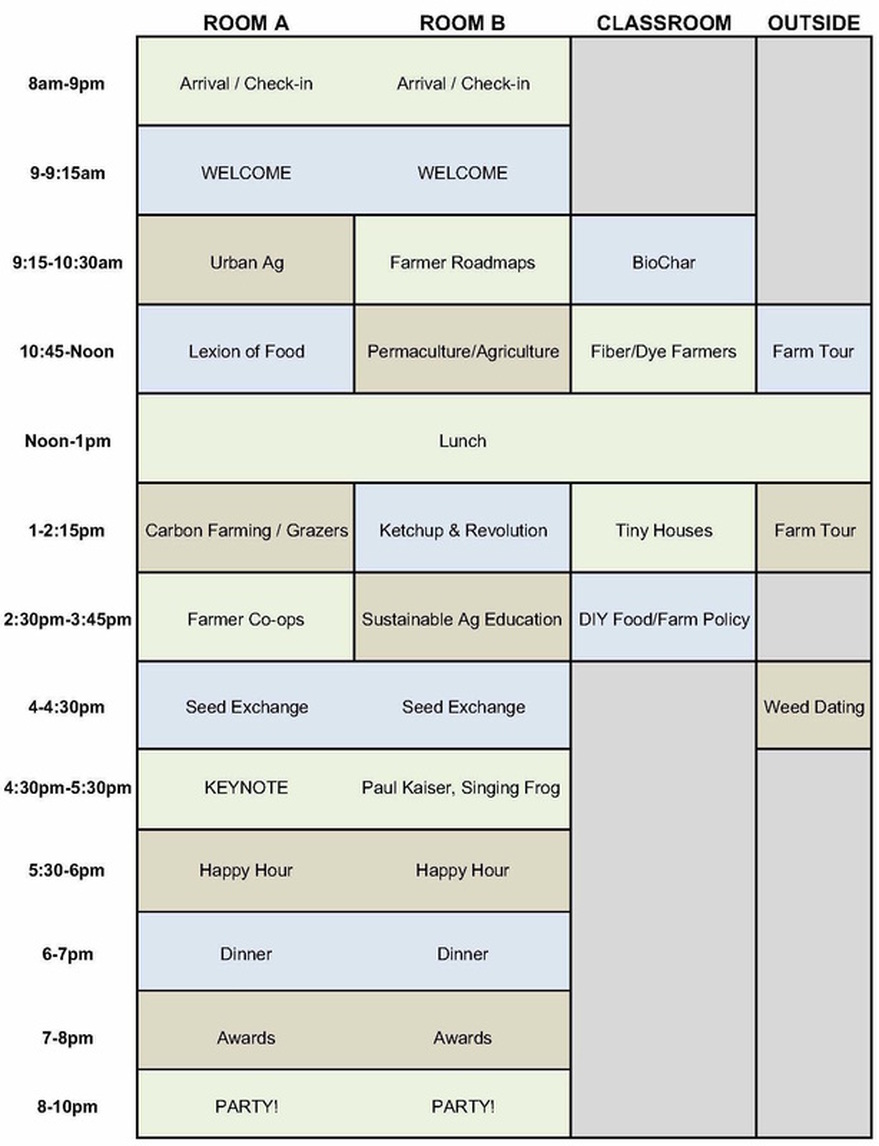
2016 SCHEDULE & WORKSHOP DETAILS: FEB 20
|
URBAN AGRICULTURE: GROWING FOOD IN THE CITY
For the first time in human history more people now live in cities than the country, Urban agriculture is practice by over 800 million people and provides a vast amount of the food supply in other culture up to 80% in many asian cities, yet here in North America less than 10% of our food is grown within city limits. How do we successfully grow food in the city? What are the challenges and limitations that we face and what are some of the opportunities? A urban farming revival is underway as rooftops, urban lots and backyards are being turned into highly productive kitchen and market gardens. The bay area has huge potential to ride this rising tide and the climate and enthusiasm is creating the conditions conducive for a food revolution in how we grow, process and distribute food within the urban sector. We will discuss some of the key ingredients fueling this movement and hear about some really exciting projects for profitable urban farming. Benjamin Fahrer, Top Leaf Farms and the Urban Bay Area Farmer’s Guild FARMER JOURNEYMAPS: VISUALIZING THE REAL-WORLD STEPS TOWARD SUCCESS
90% of farms in the US make a negative median income according to the USDA. Many of these struggling farmers are small-scale first generation farmers entering the farming field without an agricultural background because they have a strong belief that they can change the status quo to create a more sustainable food system. In collaboration with Kitchen Table Advisors (TKA), Stanford University's FEED Collaborative worked to understand what common threads exist amongst successful farmers as a way to help guide aspiring farmers. In creating these “Journeymaps” with KTA, we’re giving the younger generation a framework to see what’s already been done, what potential opportunities and pitfalls exist and possible trajectories that their farms, lives and businesses could take. This way, younger farmers can ask themselves specific, hard questions early on and understand key decision making moments, options and possible paths forward. Using human-centered design, we will be asking for your experience and thoughts to define key values and frameworks for identifying what makes more successful, resilient farming communities and how aligning business and personal values can create stronger community networks and partnerships to increase the likelihood of success achieving goals and values for farms and farm families. Sarah Mccurdy, FEED Collaborative, Stanford University THE FABRIC OF AGRICULTURE: FIBER & NATURAL DYE GROWERS' MEETUP
Get together with other livestock and crop growers interested in the leather, wool, cotton, & dye stuff products of agriculture. What are issues faced by those growing livestock & plants? How do we get those non-food products sellable? How can we deal with obstacles to production? What are issues surrounding selling those products at the farmers markets? Whats bill AB 1871? And what's climate beneficial wool? To learn and discuss these issues, please join us! For producers & those interested in the grassroots issues for fiber production, and the development of fiber agriculture in California. Marie Hoff, Capella Grazing Project TAKING BACK THE LEXICON OF FOOD
It has been proven that when consumers understand the true meaning of words, and the true cost of their buying habits, they will support a more sustainable food system. Unfortunately, this information is often corrupted and co-opted by the green-washing of corporate interests. As producers and good food advocates, we will gather to identify and localize solutions to share as a new lexicon of food. Together we will create new ideas for promoting key terms and principles that can help consumers to be more informed about the food they buy. With your help we can help deepen the bonds of our community around our shared agricultural treasure here by the Bay. Samantha Harmon and Laura Howard, The Lexicon of Sustainability AT THE INTERSECTION OF PERMACULTURE & AGRICULTURE
Often cast as the “alternative” to agriculture, the emerging practice and philosophy of Permaculture is today attracting a whole new generation of greenthumbs. But with our food system still generally beholden to self-proclaimed Agriculturalists and the loose movement dubbed Permaculture ever-broad in scope, what challenges and what opportunities exist within the overlap as well as the clash of these two worlds, in name, practice and culture? And what might the relationship between them mean for the future of new farmers and of our food? Erik Ohlsen, Permaculture Skills Center; Paul Kaiser, Singing Frogs Farm; Gowan Batist, Fortunate Farm; Caiti Hachmyer, Red H Farm; Moderated by Miriam Volat DIY BIOCHAR AND THE CONSERVATION BURN TECHNIQUE
Biochar is a form of charcoal (mostly pure carbon) that is suitable for use as a soil amendment, and lab studies and field trials have shown its ability to increase soil moisture levels, promote soil microbiology, improve cation exchange capacity, and increase plant productivity. Its use is also a promising strategy for sequestering carbon safely and beneficially, thereby addressing climate change. While biochar is currently expensive to purchase and mostly used for high-value crops, you will learn how to make it yourself using a simple technique called the Conservation Burn or in small kilns—allowing you to experiment with it on your farm. You will also learn why there are many different types of biochar, how to condition it before use, and about a number additional on-farm uses for it beyond helping to grow healthy soils. Raymond Baltar and Miles Atchison, Sonoma Biochar Initiative, a project of Sonoma Ecology Center GUILD GRAZIERS GATHERING FOR CARBON FARMING
Calling all grassland goons, pasture pushers, and forage fiends. In this session we'll be circling up to discuss our common causes of producing excellent animal products while stewarding grazing land into greater health and productivity. We'll also be hearing an update on some new carbon farming opportunities that all graziers should know about. Bring your questions, your opinions, and your needs so that that we can address roadblocks and create opportunities to develop a more robust grazing community on land-bases large and small. Ariel Greenwood, Holistic Ag; Renata Renata Brillinger, CalCAN; Erin Axelrod, Lift Economy & the Compost Coalition of Sonoma County DIY POLICY EMPOWERMENT FOR SMALL FARMS
What if every person takes charge of advocating for and passing just one law? To create economically resilient communities, we need to change or create millions of city, state, and federal laws. In the agricultural context, these new laws would remove barriers to and create incentives for local food production, sustainable farmland financing, worker-owned enterprise, shared housing, local food processing, farmland preservation and other aspects of thriving agricultural communities. SELC will present a road-map to passing high-impact policies, share our experiences introducing and passing legislation, and lead the participants in developing their personal policymaking goals and plans. Come away feeling empowered and ready to make new laws! Dave Runsten, Community Alliance with Family Farmers; Neil Thapar, Sustainable Economies Law Center KETCHUP & REVOLUTION: SMALL FARMS CONFRONT ECONOMIES OF SCALE
What do ketchup and California's local food revolution have in common? In this Cal Ag Roots podcast "listening party" you'll hear the story of how the invention of the mechanical tomato harvester changed California farming in ways that nobody could have predicted. Invented at UC Davis in 1962, the tomato harvester was a major agricultural engineering triumph-- and it put thousands of farmers and farmworkers out of business. Ildi Carlisle-Cummins, Director of the Cal Ag Roots Project at the California Institute for Rural Studies, will narrate this story, which will change the way you think about food movement work today. We'll have plenty of time for dialogue about the story and about the food movement's current role in shaping the UC research agenda. Ildi Carlisle-Cummins, Cal Ag Roots & California Institute for Rural Studies NEW FARMER & FARMWORKER HOUSING: A TINY HOME SOLUTION?
Amid a statewide housing crisis spurred by skyrocketing real estate and rental costs, new farmers are no longer just struggling to find farmland, but also homes in which to live during their start-up years as well as affordable housing for their interns and employees. The vision of Shone Farm's new Tiny House Club is to create a housing program that not only provides farm students with an opportunity to directly participate in the building and ownership of their own home, but also to provide students and future farmers with sustainable housing. Chelsey Kolbeck, Shone Farm & SRJC Tiny House Club FARMER COOPERATIVES: BANDING TOGETHER FOR SUCCESS
Learn about agricultural cooperatives. We’ll cover the basics of starting, structuring, and running a co-op, and how cooperatives compare to other organizational structures. We’ll also share case studies, including some local examples. We and the North Bay Flower Collective will discuss their process of exploring cooperative solutions to: business development, resource access, marketing, and knowledge sharing. Don’t miss this opportunity to understand co-ops from cooperative developers and your peers. Luis Sierra & Mai Nguyen, The California Center for Cooperative Development; Nichole Skalski & Heidi Herrmann, North Bay Flower Growers Collective EDUCATIONAL OPTIONS FOR THE NEXT GENERATION OF FARMERS
In just the next 20 years, 400 million acres of American farmland will change hands. That's the size of California... times four. Meanwhile, we’re now learning that a huge shift in how we grow food is necessary to preserve the natural resources on which we rely and to restore the equity of our local communities. Luckily, not only is there a whole new generation ready to roll up their sleeves, but in just past few years, a dozen innovative, new educational programs have emerged here in Northern California to help prepare the next crop of farmers and ensure a stronger local food system. Come learn more about them here! Center for Land-Based Learning, Farm Academy Grange Farm School Permaculture Skills Center, Farm School Shone Farm, SRJC Growing Roots, University of California, Berkeley UCCE, Farming 101 & Incubator Farm SHONE FARM TOUR
Shone Farm is a 365-acre outdoor learning laboratory for the Santa Rosa Junior College’s Agriculture/Natural Resources Department. The farm provides students with hands-on experience that cannot be duplicated in the classroom. Join us for us for a tour Shone's 120 acres of forest, 100 acres of pasture, 70 acres of vineyard, 12 acres for crop production, and 4 acres of olive and apple trees, one of the largest agriculture sites in the California Community Colleges system. In addition, there is open space around the farm’s perimeter that serves as wildlife habitat, as well as the farmstead, which includes various buildings and improvements. Leonard Diggs, Shone Farm Manager KEYNOTE: PAUL KAISER, SINGING FROGS FARM
Paul Kaiser runs Singing Frogs Farm, a unique, no-till, ecologically beneficial, highly intensive vegetable farm in Sonoma County. Through innovative systems, including no-till soil management, Paul--along with his partner and wife Elizabeth--have more than tripled the organic matter in their soil, all while producing more than five times the state average of crops per acre and while bringing back tremendous, healthy populations of pollinators, beneficial insects and vertebrates (natural pest control). Not only do they use less water to produce vegetables because of soil organic matter, they also use NO sprays of any kind, not even organic sprays, and their crew of year-round employees (not seasonal) have job security. GET YOUR TICKETS HERE: |
