• Home
  • About
    • About the Farmers Guild
    • The Guild in the News!
  • RESOURCES
    • Join Our Mailing List
    • Jobs, Internships & Land
    • Start A Guild
    • Scholarships
    • CCOF Fee Waiver
    • Kiva Zip: 0% Interest Loans for Farmers
    • Mentors
    • 12 Ways to Make the Most of Your Guild
    • More Resources for Farmers
  • Friends
    • Intern
    • Volunteer
  • Blog
  • EVENTS
    • Beyond the Vote
    • Entrepreneurial Intensives, 2016-2018 >
      • Yolo: March 12 & 13
      • Mendocino: April 17 & 18
      • Sonoma County: Dec 3 & 4
      • Nevada County: Jan 9 & 10, 2017
    • PAST EVENTS >
      • Yolo Farmer Buyer Mixer Feb 25
      • 3rd Annual Farmers Guild-Raising 2016 >
        • 3rd Annual Farmers Guild-Raising 2016
        • 2016 Guild-Raising Schedule & Details
        • Home-Stays: Feb 20th
        • Awards 2016
      • Farmer Film Fest: Feb 21
      • Agrarian Lovers Ball: Feb 20
      • Profitable Urban Farming with Curtis Stone
      • Going Organic Workshop - Jan 11
      • Farmer / Buyer Mixer: Dec 1st, 2015
      • Harmony Hoedown: Nov 6
      • An Evening for the Next Generation of Food: September 20th
      • 18 Reasons Dinner in SF: August 19
      • Going Organic Workshop: July 22
      • Wine + Water at Bom Dia: July 19
      • Yolo Farmers Guild Summer BBQ: June 12
      • Farmer Olympics & BBQ: July 7
      • Photo Contest: Who's Your Farmer?
      • Growing Our Farmers in Sonoma County: Farmland for Farmers
      • Water Efficiency Workshop for Vineyards & Diversified Farms: April 14
      • 'Food Chains' Screening: April 7th
      • Farmer / Buyer Mixer: March 23
      • Valentine's Day Ball: Love Your Farmer!
      • Guild-Raising 2015 >
        • Details: Guild-Raising 2015
        • Home-Stays: Feb 14th
      • Ag-Tech Mixer: Jan 6th
      • Guild Holiday Party: December 13th in Sebastopol, CA
      • Entrepreneurial Intensive: December 2014 >
        • Entrepreneurial Intensive: Details
      • Berkeley Cookbook Release Party: December 10
      • Pizza Party & Farm-Fresh Topping Contest: Aug 28, 2014
      • Summertime Farmer Fest: July 1, 2014
      • Free Farmers Campaign 2014
      • Guild-Raising: February 2014
  • Farmstand

Useful resources

  • Trang Cá độ Bóng đá
  • Top Bitcoin Casinos Malaysia
  The Farmers Guild

New Farmer’s Tool Box #3 National Young Farmers Coalition

3/23/2016

0 Comments

 
​Who Are They?

The National Young Farmers Coalition is a grassroots organization founded on the guiding principles of fostering the next generation of farmers, whether they are first year apprentices on a farm or someone looking to make a career change. They support practices and policies that will grow and support the farmers of today and tomorrow.
 
(
www.youngfarmers.org) 

​What Do They Grow?


The National Young Farmers Coalition was founded in 2009 first and foremost by a new generation of farmers looking to support their peers. It started out as a conversation between three young farmers who were discussing the challenges facing them and others in their shoes. Challenges many young farmers face include securing loans, access to affordable farmland, and student loan debt. NYFC seeks to break down these barriers that young farmers are facing today. The coalition is headed by a board of directors, including farmers, farm service providers and social entrepreneurs. Not only are young farmers part of the coalition but a range of members that include, but are not limited to, established farmers, farm service providers, good food advocates and conscious consumers are also part of the movement. The coalition supports independent family farms, sustainable farming practices, affordable land for farmers, fair labor practices, training and more.

The National Young Farmers Coalition also provides information to starting your own chapter in your region. NYFC chapters support advocacy, policy change, and partnership between those in the community. The chapters are a platform for young farmers to build success in their own endeavors, as well as providing support and connection to their peers. Currently there are 26 chapters in 25 states.

How Do They Help New Farmers Grow?

Here are some ways The National Young Farmer Coalition can help you:
  1. RESOURCES- Get plugged in with a directory of resources that range from farmer to farmer training in your state to getting financed.
  2. LAND AND JOBS- Are you looking for land, a job or an internship? The National Young Farmers Coalition has a comprehensive list of different data bases that will connect you to what you are looking for. The national listings have something for everyone no matter what state you are in.
  3. FINDING THE RIGHT CREDIT/ CAPITAL- Finding the finances to pursue a job in farming is often one of the most daunting tasks a young farmer faces when starting out. Get your foot in the right direction by learning what types of credit and capital options are available to you. The coalition lists and gives a brief description of different loans that are available for farmers to get you started.
  4. GET CERTIFIED ORGANIC- The coalition provides a guide on the steps to getting USDA Certified Organic.
  5. GET CONNECTED- The website provides a forum for you to get connected with other farmers if you have any questions. Subjects include anything from policy, farm life and business management.
Blog by Alyse DeLeon
0 Comments

Blood & Mud: A Love Letter To Cross-Generational Farm Communities

2/8/2016

8 Comments

 
Written by Gowan Batist of Fortunate Farm.  Photography by The Hidden Sea.
Gowan works 40 acres of beautiful, coastal farmland in Caspar, Mendocino County.  She shares her land with heirloom vegetables, large windrows of compost, and one flock of sheep.  ​​

 The Farmers Guild has taken me to some strange and beautiful places over the years. From a tent in a citrus orchard in Temecula to an ancient farmhouse in Northern Italy, we’ve gone out and had fun and learned a lot. In many ways, our gatherings seem like a big party; we drink beer, see friends, and sometimes dance. Opportunities to make connections, visit other farmers, and have a good time make up the majority of my Farmers Guild experiences.
 
I was reflecting on this the other day as I lay prostrate in bloody straw, panting with effort as I milked blood out of an udder so tight I could barely get my fingers around the teat.
 
A neighbor had messaged me with a terrible situation. Her ewe had delivered stillborn lambs sometime the day before and her un-nursed udder had swollen to a floor-dragging, purple and black monstrosity. My neighbor is an intelligent, capable, older woman but this was way too big of a job for her to tackle alone.

She told me that although many people on her road had farmed (actually the area used to be famous for dairies and poultry farms), they were all much older than her. She was out of time and options.
 
She reached out to me because of the Farmers Guild, where she'd learned that I too had dairy sheep.
 
When I arrived at her barnyard, I was stunned by the condition of the ewe. When I spoke to her on the phone I wasn’t overly concerned. I had milked out an overly tight goat’s udder last season for another neighbor and while her bag was pale and painful and the goat was in distress, it was quickly relived and back to normal. I pictured a scene with teats that were difficult to milk because of the tightness of the bag and the discomfort of the ewe. This was different. Her bag had filled to literal bursting and broken blood vessels colored her teats purple at the top and black at the tips. She couldn’t walk or lie down and was alternately moaning and grating her teeth with a sound like a bad transmission refusing to slip into gear. We carried the poor ewe into the barn and my neighbor held the ewe's head while I braced my shoulder into her side, pushing her against the wall and tried her teats. Pure black blood gushed out.
 
I had a friend last season whose ewe burst a blood vessel in her udder and I had poured a bucket of the pink-tinged milk into a trough for my happy hogs. This was different. This was the color of red wine with the lees left in. I desperately wanted to call a vet and relinquish responsibility for this ewe. I wasn’t even sure if milking her out was safe, thinking it might worsen her bleeding. But in our rural area we only have one mobile large-animal vet and she was at least 8 hours out. The ewe was suffering more profoundly than I had ever seen a sheep suffer. The only thing we could think to do was relieve the terrible pressure.
 
An hour later my wrists were aching.  My pant legs, hair, and jacket were covered in blood. The blood was full of small clots that caused the teat to spray wildly, mostly all over me. My face was a stiff mask of droplets of bloody milk.
 
In this moment of intense, miserable effort I was hit with a wave of gratitude.
 
We all know that we need a rural network of support. The neighbor support network is something I grew up with - something infused in rural culture based on decades of familiarity and shared efforts toward group well-being.
 
In our current shattered context, with farmland going under for development, more and more young farmers trying to enter the field every day, and fewer older farmers there to nurture them, those ties don’t come ready-made for everyone. Many of my peers are from the city or suburbs, or are farming in rural communities different from the ones they grew up in.
 
The Farmers Guild gives us a chance to meet with the shared knowledge that we’re in this together. Whether you’re a 4th generation rancher or an urban permaculture student, you can go to a Guild and find people working on the same project that has defined our occupation and largely our species since the beginning of time: the quest to live on land and be supported by it while improving it, instead of degrading it.
 
Community is messy. We don’t always agree and well-being as a group project is often full of moments where what needs to be done is what you least would like to be doing. That, however, is what life connected to the earth is like, and we all share that experience.
 
As I drove home I passed a For Sale sign in the front yard of a farm I had loved and learned a lot on. I remembered learning to milk in the old barn years ago, and nights around a lantern watching the presentation of little feet and a little nose diving into the world. If that farm, now gone, hadn’t been there I would have been less prepared to help my neighbor. If I can’t keep body and soul together on my farm, I won’t be able to help others learn the skills they need to live this life.
 
When old timers know what needs to be done and can’t do it, and young folks could do it if they knew how but they don’t, we lose our heritage.
 
The Farmers Guild is something we’re creating collectively as we go along. Like most brilliant ideas, it's obvious - something we all know - not something that sprang uniquely from the mind of one person or institution. I’m grateful for the Farmers Guild, even in the rain, down in the mud, wrestling with bloody sheep teats. I’m so grateful I have people to call in my moments of distress. I’m so grateful I can be the neighbor on the other end of the phone when the rock of Must meets the hard place of Can’t, with a person and an animal in-between.
 
With the successful funding of our own Mendocino County Wool Mill coming just a week after this experience, I feel like someone who is witnessing the birth of a new era, watching it kick and struggle and bleat into being. We’re going to have more neighbors who will raise sheep. We’ll increase our flock. New challenges will come and my neighbors will help me when I get in trouble and I’ll help them.
 
And once per month we’ll gather, have a beer, and knit the social fabric that acts as a safety net and a banner, the individual colors and textures coming together to form our community and our Guild.

P.S. The ewe recovered nicely and is currently out grazing in the pasture.


When not dealing with crisis situations, Gowan can be found in the early morning hours milking her small herd of ewes, walking with them to the fields, and giving kisses to the lambs.
8 Comments

Grange Farm School Graduates: Graze Hard, Rest Well

12/16/2015

0 Comments

 
~ RUTHIE KING

The day before the second graduating class at the Grange Farm School received their certificates, gifts, and parting words of wisdom from staff, friends, family, and community members, the Grange Farm School took a field trip to the Mendocino Coast. There we learned from and herded approximately 400 of Leland Falk’s intensively grazed flock of sheep at Sea Ranch and met his grazing colleague Mark Biaggi.  Mark and Leland graze marginal pasture up and down the coast to mitigate fire threat and reclaim degraded soils.

The concepts behind holistically managed, grass based livestock rotation, inspired the theme of the graduation speech for the Farm School students: Graze Hard, Rest Well.

Practicum Student Program graduates worked intensively at gaining the essential skills necessary to operate a successful (profitable, responsible, values driven) farm or ranch.  They “grazed hard” on the available information, our dense network of experts and mentors, the opportunity to learn experientially.  Now they have completed the program and it is time to ruminate, chew the cud, absorb and reflect.

After preparing a meal of primarily Farm School grown produce (fried banana squash, black eyed peas, stewed collard greens in GFS chicken stock, sweet potato pie, and a hearty salad) the students sat down to dinner with their community.  Jamie, Danny, Joshua, Riley, and James lived and worked together for three months acquiring a toolbox of skills covering crop and soil science, livestock management, industrial arts, business management and interpersonal relationship strategies.

Fortunately for Northern California, all of the graduates this term are interested in working in the area.  In fact, one secured a job before she even graduated! Read more about the Farm School graduates, including Jamie, in 
this article by the Willits News:


Jamie Golden, who was unsure of what she wanted to do in agriculture at the term’s start, will be joining the farm crew at Open Field Farms, a 500 acre biodynamic community supported agriculture farm in Sonoma mid-December. Only several years old, Open Field is entirely owned by its members with the goal to “provide all their food,” including produce, meat, eggs, grains, beans, and other diverse offerings.
​
“The program was really good for me to get a sense of what I was interested in, and then find a farm like that,” elaborated Golden, saying “I came here unsure of what I wanted to do, and now I’m leaving with a job.”
Next term begins in April, and we are accepting applications now!  Check out our website for more information, or contact us with questions.
0 Comments

Farmers Guild Community Raises over $18K for Wildfire Victims

9/19/2015

5 Comments

 
Picture
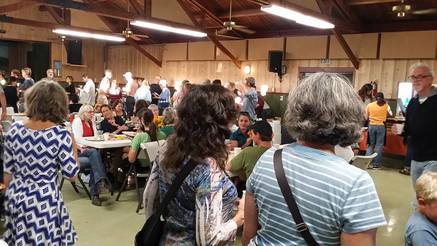
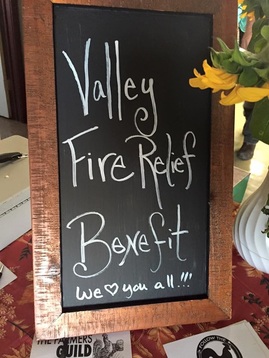
On Thursday evening, while thousands fled the devastation of Lake County's Valley Fire that has so far consumed hundreds of homes and over 70,000 acres, our humble Grange Hall in Sebastopol, just sixty miles south of the inferno, overflowed with farmers, chefs and local food advocates who together raised over eighteen thousand dollars to aid victims of the wildfire.

Three days prior, when news of the fire was just appearing in headlines, Shannon Erickson Lee of Two Moon Family Farm in Sonoma, CA, posted on the Farmers Guild online forum "Can we maybe mobilize a farm-to-table potluck somewhere to raise funds for our farmer/ranch guild friends in lake county???" That spark soon set off an inferno of its own. First came Kerrie Williams, who wrote "I'm really good with organization and would love to help! I graduated from middletown high and have been looking for a good way to help." Then Rob Hogencamp 
chimed in, Executive Chef of Sonoma West Medical Center, volunteering to help cook. And nearby Laguna Farm offered to drop off fresh produce. Robin Carpenter, of KWMR's Farm & Foodshed Report, began to coordinate a silent auction. And by the time Sarah Silva of Green Star Farm, Marianna Gardenhire of Forestville's Backyard Restaurant and a dozen others jumped in the fray, we at the Farmers Guild had no choice but to appease the masses and begin to organize.

Picture
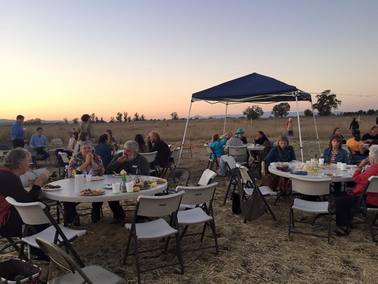
As an organization specializing in community events, never have we seen a group that large, that committed and that effective mobilize in such a short span of time. Three days in, with several hundred RSVP's, local businesses piling up auction items, and farmers dropping off truckloads of ingredients, the only question on our minds was: how will we fit them all? But by Thursday evening tents began to arrive, extra chairs and tables appeared outside, and even a local brewery tour company pulled up in a bus, offering to shuttle the crowds from our little Grange hall to an overflow parking lot down the road. 

Those eighteen thousand dollars came not from a handful of high-rolling sympathizers, but from the collective contributions of nearly four hundred people. And while we were pleased to see many new faces that night, most of the crowd was familiar, comprised of regulars from the Farmers Guild, i.e. young and small-scale farmers, most of whom struggle to make ends meet, but who nonetheless arrived to give of their time, money, skills and compassion.

Defining the Farmers Guild has never been easy. An advocacy group for agriculture? An educational program for young agrarians? Some get a glance at what we do and say, well, it's nothing but a potluck! And they might be right. For several years, while we've hosted workshops and trainings, advocated for policy change and educated the public on agricultural issues, at the heart of our work is a simple, monthly potluck. A couple dozen farmers, ranchers and local food advocates get together in a barn or Grange hall, share a meal, and talk shop.

Picture
But a potluck can be powerful. Whether it's the Grange or the Farmers Guild, a neighborhood group or a house of faith, cultivating the space for communion bears many fruit. Most of the time that fruit is hard to see, harder still to measure—relationships, inspiration, invisible threads spun throughout a community. On rare occasions, however, that impact is obvious. Even measurable. Like on Thursday evening. Three days to plan. Eighteen thousand dollars. Forty-three auction items. One Grange hall. Four hundred people. 

For those in Lake County who've lost homes, crops, cars, livestock, businesses, photo albums, and even family members, we know that eighteen thousand dollars will make only a dent. And some things are irreplaceable. But we also know that ours is only one community of many. And so to all those who gathered with us on Thursday and all those who are, in their own communities, mobilizing to help those in need—and more importantly, to those who cultivate community even when giant billows of smoke don't waft overhead—I thank you.

~

The money raised, currently held by our non-profit, will be dispersed in the coming weeks in partnership with organizations in Lake County who are working directly with the victims of the wildfire. A portion will go specifically to help small-scale family farmers and ranchers rebuild barns and fencing, feed displaced animals and recoup losses from this year's harvest. 


To get involved, contact us here

5 Comments

SOURCE LOCAL, SHOP LOCAL: A GROCERY STORE CHALLENGE

9/1/2015

1 Comment

 
SAFEWAY: A neighborhood that spans 800 miles
“Go Local!” commands the sign above the Safeway produce aisle. “Support Farms in Your Neighborhood!” With one in three people surveyed by a national market research firm claiming they’d pay up to 25% more for local food, it’s no surprise that this retail behemoth would jump on the locavore bandwagon.

But with no universal measuring stick—nearly all of Safeway’s “local” produce travels several hundred miles or more from vast corporate farms—what’s to keep those same tactics from becoming par for the course among all grocers?

This summer, The Farmers Guild invites you to join us for “Source Local, Shop Local,” a grassroots campaign to verify those enthusiastic claims of neighborly support and give credit where credit's due. Our initial survey covers several grocery outlets in and around Sebastopol, CA, tallying the number of products sourced from local growers. (But we encourage you to replicate this survey in your own neighborhood and share the results.) We’ll then conduct the same survey next year to see which of these businesses has worked to better align message with content. And in the meantime, we at the Farmers Guild are here to make introductions between farmers and grocers, identify obstacles, and engage our wider community in this movement to build a more transparent local food economy.


SAMPLE #1: WESTERN SONOMA COUNTY
Even here in the epicurean North Bay, we found that what’s playing out beneath the fluorescent lights of Safeway also plays out within some of those stores who implore us to "shop local". Truth is: while the image of neighborhood farmers is helping to derive that extra 25% revenue, farmers don't always seeing their fair share of it. And the more we spoke to grocers, the more we realized that the bigger issue at hand here is this: those grocers who will shift their buying patterns—often a real investment of time and money—will do so in competition with grocers who are profiting from the same message but with different content.
NOTES ON OUR PROCESS:
- We defined “Local” as grown within the county or in surrounding Counties (Marin, Mendocino, Napa)
- Results are limited to fresh fruits and vegetables
- All data was taken within the same week in September, a time when local farms overflow with bounty
- Survey process was done in collaboration with employees of each subject store
Business                   # of local products
Healdsburg SHED:                 53
Oliver's                                     39
Whole Foods, Sebastopol     38
Community Market:               31
Locastore                                 19
Andy's                                       15
Whole Foods, Petaluma         8
Pacific Market:                         4
Safeway:                                    3

   MORE RESULTS COMING SOON...
PACIFIC MARKET: Shop Local, Source from Mexico
It’s easy to scoff at the blatant fraudulence of a $14 billion company cuddling up to your neighborhood values. Safeway’s co-opting of a movement towards sustainable local food-sheds deserves careful vigilance. And while buying direct from growers is the best way to build stronger local food systems, after more than a decade of explosive growth, sales of local food at farmers' markets are now slowing nationwide. While there may be several causes for this, the fact that more and more traditional grocers are today using the same language and ethos born of the farmers market and CSA's must certainly play a role in the downward trend.

The obstacles to local sourcing aren’t imaginary. Each store struggles with their own unique challenges, complicated by a globalized food system well beyond their own control. Where land and labor is cheaper, so too are the vegetables. Meanwhile many smaller farms forgo certification, even if growing organically, which hinders stores that guarantee only certified produce. Still, many local stores are actively and honestly working to procure more local products. But in a sea of vague marketing schemes, if customers can’t tell the difference, will such efforts convert to the dollars they'll need in order to compete with Safeway and the rest?


THE SILVER LINING
A corporation the size of Safeway would never invest in such campaigns without careful market research, the ability to assure shareholders that such efforts translate into consumer spending. Understood from another perspective: the average American consumer today cares where their food comes from. They value their local economy and sympathize with small family farms that could, hypothetically, belong to their “neighborhood” and therefore operate with a different set of business values. These sentiments no longer belong to the birkenstock, granola fringe. Today a deeper understanding of our food system is emerging into the mainstream. But the job of holding businesses accountable to such claims does not belong to marketers; that's up to us.

JOIN US!

Simply visit grocery stores in your neighborhood, inform them of what you're doing, and then replicate our study. Begin a dialogue by kindly informing these businesses that your intention is to assure that any efforts they take to source from more local farms deserves recognition. And if possible, offer to introduce them to more local growers, listen to their challenges, and consider how we can all help farmers meet their real-world constraints.

And please, share the results! Contact us. We'll post them here.
1 Comment

Will Code for Farms: Volunteer Profile, Lauren Elizabeth

8/25/2015

0 Comments

 
Whether busy in the field or in the kitchen, those working on the front lines of our local food movement often don't have time to sit down at a computer to tell their stories. That's where Lauren Elizabeth comes in. With web-savvy skills and an artful eye, Lauren joined the Farmers Guild this past summer to help build an online tool we called "Follow the Rooster", an interactive website that captures the stories of local food heroes, maps the next generation of farmers, and invites everyday people to recognize the unique actions that help build a more sustainable way to feed our communities. 

Lauren Elizabeth is the mastermind behind Ruffles Art Studio in San Francisco. She makes fresh, fun designs for small businesses with a specialty in bringing a handmade, organic element to websites, business cards, logos and other collateral, and walking the lines between illustration, photography and design.

According to Lauren, "Making the website and artwork for Follow the Rooster was super fun! I wanted to get involved in this project because local farms are not only small businesses, but one of my favorite kinds. I live in the city now, but my heart will forever live in the country. As a kid, some of my happiest days were spent raising fancy rabbits, chasing chickens, riding horses and learning how to keep every animal around. From goats to gerbils, I wanted to learn how to take care of it (and photograph it, and draw it). My first design projects were making illustrated logos for show rabbit folks - not many people had logos for their rabbitries back then. Those little logos helped offset my art school costs, made people happy and made rabbitries memorable. I still see people using them at the rabbit shows - design is timeless."

Lauren came to professional design work through starting a pet photography and portrait studio. There she learned just how important branding, marketing and design is when you’re small--like most of the farmers who gather at the Guild each month. It’s critical that these kinds of businesses stand out from the crowd and find the right customers. "You’re not trying to attract everyone," says Lauren, "It’s very personal, and it can be tricky to see what makes you unique. But those differences are your biggest assets! You gotta rock what you’ve got."

If you’re a farmer, crafter or maker in need of design or website work, visit  www.rufflesartstudio.com or send Lauren an email at [email protected] and mention Follow the Rooster - she'll help you grow some delicious organic designs!
0 Comments

On Burnout, by Farmer Joey Smith of Let's Go Farm

8/11/2015

1 Comment

 
It’s that time of year when all of our hard work pays off.  Our tomatoes ripen, the zucchini won’t quit growing, and all those peppers, eggplants, melons (all the heavy stuff) start rolling in. I speak as a vegetable farmer, but this applies to anyone working the fields, pastures, orchards and more: It’s time to talk about burnout.

My definition of “burnout”: when someone who loves something so much they do it so intensely that within a few years they're forced give it up. After burning out, they would rather do anything than the thing that brought them so much joy…. the ultimate tragedy.

I see traces of burnout in most younger farmers I meet. It’s a taboo word, but the consequences are too dire to bury under guilt and shame. So let’s talk about it! It’s a natural consequence of giving 110%, harvesting by headlamp, working so many markets that your smile muscles wear out. So here they are, my ten recommendations for avoiding burnout:


1) Get together with your peers - Guild meetings, EcoFarm, Hoes Down, Small Farm Conference - we have a wealth of convergences nearby, and often.  We can use these meetings to vent, to share resources (and food!), to spread awareness, and to laugh at the vagaries inherent in land-based work.  While solitude is good (and necessary!) - isolation is something that can really accelerate burnout.

2) Practice saying 'no' - even to customers!  If you're working off of plan (see #10), how does this latest opportunity fit into your plan? If it doesn't - can it wait 'til next year? The road to burnout is paved with good intentions.

3)  Read poetry before your workday. With other people if possible.  Aloud.

4) Take time to stretch and keep your core strong.  Try to reduce the role of physical injury via prevention.

5) Do something that isn't farming.  Write it into your calendar.  Hike. Surf. Lie in a Hammock with a  good book and a gimlet.  Go to the Movies.  These are the things that keep us sane, and over the long haul, taking time for them will keep your love of land-based work from feeling obligatory or forced.

6) Talk to older and/or more experienced farmers.  Explicitly ask them about experiences with burnout. Seek them out. Some of the best reminders for me to slow down and enjoy the beauty of a life in agriculture have been people in their 60's and 70's, reminding me that life is short - and they also have really great tips on how to do things more efficiently, and stories that illustrate mistakes to avoid.

7) Embrace labor-saving technology.  But not so much that it takes the fun out of it for you.  Machines and computers can really make the difference - but be aware of the 'treadmill' effect of running faster and faster (i.e. buying more and more tractor implements) to stay in one place.   For example, my golf-cart is the most useful tool on the farm, because the energy and time it saves us from schlepping things back and forth can be put into other pursuits.

8) Normalize the fact that people who work the land also go on vacation!!  It's important to get away, and to meet people in other places - see how they farm if you like, but go, go, go.  

9) Be explicit about your goals - write them down.  There is no downside! It's not a contract with anyone. It can change. But having it written and visible can really help keep you oriented when confronted with an opportunity or challenge (or with general chaos). Ask yourself: "What does success look like to me?"

10)  Off season planning - This can and will save you time later on.  Make a map of your field/pasture and have an 'ideal plan'.  Write down how much money you want to make, and how you're going to make it.  Refer to this throughout the year to help guide decision-making. Why plant more tomatoes next year if you couldn't pick them all this year?  How can you make sure that there is lettuce in every other CSA box for 30 weeks?

Joey Smith,
Owner/Manager, Let’s Go Farm
Santa Rosa, CA

1 Comment

New Farmer Toolbox #2: Permaculture Skills Center Farm School

7/14/2015

0 Comments

 
WHO ARE THEY?
The Permaculture Skills Center is a 5-acre demonstration site and educational institution dedicated to sharing regenerative land development and management practices. They are located in the Laguna de Santa Rosa watershed just south of Sebastopol, in Sonoma County, California. 

WHAT DO THEY GROW?
Since winter 2012 PSC has installed over 2000 feet of stormwater harvesting earthworks, four habitat ponds with constructed wetlands,  two acres of rotational grazing pasture lined with on contour hedgerows. They rotate a mobile chicken coop that holds one hundreds pasture-fed chickens and a pair of alpaca, and a llama for natural fiber generation. They planted 250+ heirloom fruit and nut trees with hundreds of medicinal, soil-building, insect-attracting and edible plants as an understory. They now have one acre of vegetables, strawberries and cut flowers, plus an outdoor classroom and market stand. 

Furthermore they host one-day educational workshops and tours, sustainability related community events and our two vocational training programs – the Ecological Landscaper Immersion and Farm School– all of which use the site as a living learn-scape. 

Farm School is Permaculture Skills Center's newest vocational training which focuses on growing livelihoods supported by regenerative land management in agriculture. Using the innovative farms of Sonoma and Marin Counties as a classroom, students have opportunity to learn and mentor with the region's leading-edge producers and food system innovators, get business coaching, tour successful models and expand their community of support.

Farm School is an 8-week farm and business skills intensive followed by a 6-month mentorship.  (Could also insert the image attached here which gives a nice visual of the program)


HOW DO THEY HELP NEW FARMERS GROW?
We asked the Permaculture Skills Center for the top five ways and reasons to connect with them for their farm school, and here they are:


  1. To learn from the leaders - Farm School provides the unique opportunity to learn from a wide spectrum of pioneering practitioners in an integrated fashion, all who represent different pieces of the new paradigm of agriculture.  
  2. To develop skills - whether its’ soil management, crop planning or farm design, this program roots new knowledge by teaching it through useful real-world application.  
  3. For business training - acknowledging that a farm enterprise's finical sustainability is core to perpetuating its ecological sustainability, this program integrates business design, development and management trainings each week.
  4. To find focus - since it's easy to spread yourself thin by taking on too much when getting started, Farm School helps you get clear on your piece of the puzzle and then create a farm and business plan to align passion and profitability.     
  5. For mentorship and community - because none of us can do it alone, Farm School is as much about growing a network of peers and mentors as it about cultivating your skills. After the 8-week intensive students are encouraged to return to the area they intend to start farming and PSC will help you set up a 6-month mentorship to support you getting started. 

MORE INFO AT:
 www.permacultureskillscenter.org


KEY RESOURCE TAGS
Farm Sustainability Consulting

Public Education  

Permaculture

Farm School
Design


Training
Written by Rose DeNicola
0 Comments

The Next Generation of Empowered Women Growing Our Food

6/24/2015

1 Comment

 
Farming in America is funny business. We have all heard the statistics time and again - it is about 60 years old, it is mostly male, it is mostly white. And it is big - be it fruit or vegetables, cattle ranches or dairies, corn or soy. It is many, many acres. It is machines. In fact, our statistics tell us that here in the USA it is often a 60 year old white man, sitting in a big machine, on a big huge farm. However, if we broaden our scope just a bit - that is, to the whole world, outside of this All American Bubble - things begin to look different. They start to look female. They often look smaller scale. 

There is often even some form of community. While in the United States men dominate the farming sector, globally, women produce about half of the food. Most of this food - most of the food that feeds the world - is produced on small farms. Small-scale farmers, herders and fisherfolk are the providers, the foundation of the community. 

As small-scale farmers we are up against a lot here in the United States. This is to say nothing of how incredibly hard the work is - I am confident saying that there is literal blood, sweat, and tears on all of the small farms I've been on (and hopefully a pre-emptive tetanus shot). There are long hours, exhausting days, sunburns and low pay. On the bootstrap operations that don't come fully funded from a lucrative past life, we are forced to be the thinkers and doers. The growers, the marketers, the bankers, the bookkeepers. We are the social media wizards, the photographers, the troubleshooters and the brainstormers. We hoe the row and we peddle our wares. It is work. 

But aside from how tangibly hard this work is, the challenge also comes from the fact that this work bucks against most clear and easy pathways set up in this American system. It challenges the rules and regulations and forces reconsideration and reconstruction - and (sigh) usually reregulation. But what makes it so very challenging is that it 1) seeks to change the cultural norms and expectations around food in this country and 2) strives for success in a system where there is little institutional support for us, and tons of institutional support for them. The big guys.

So, in true grassroots form, small-scale farmers across this country have found ways to create our own networks of support. The CSA model - if the government wont give us support come rain or shine....or in case of sleet or hail and utter crop failure....then perhaps our community will. The growth of food hubs and locally focused distribution chains - if the institutions need bulk, we'll find a way to combine forces and give them bulk. And for me, this year, the Nancy Skall Scholarship. 

Recently I was awarded the inaugural scholarship for farm improvements from a fund that was created by the family of the late Nancy Skall, a woman farmer who had been kicking *** in Healdsburg for several decades. The funds provided will afford me 25 more yards of compost this year than I can normally budget for, helping continue the transition of my farm into a no-till operation, a process I began two years ago. For more on no-till at Red H Farm, check out The How and Why of No-Till at Red H Farm. 

The development of this scholarship - and in my opinion, the awarding of the inaugural funds to a woman farmer essentially from a woman farmer - is a clear and tangible way that the Skall family is helping to create a farming community in Sonoma County. Now, I don't know what Nancy's opinions were or if she gave a hoot about strengthening the position of women or not - I don't presume to know her perspective and do not mean for my thoughts to be taken as hers. In fact, I doubt my being a woman was not even a factor in the award process - I'm quite certain it had more to do with the timing of my application and the worthiness of my project. However, to me, the development of a community-based resource that will help young or new farmers find success is huge. The awarding of this first scholarship to a female farmer is meaningful. It will take a long time and a lot of hard work to change the cultural norms around food in this country. 

It will take just as much work to develop systems of institutional support for these new farmers and these new norms. But slowly and surely we are changing the statistics. We look to our colleagues around the globe and we find ways to build community-based systems of support. We are farmers helping farmers, and in this case we are women holding up women. We will continue to face adversity, but our chance of success will be stronger if we do it together.

-Caiti Hachmyer, Red H Farm

1 Comment

Can the Tiny Home Craze Help Incubate New Farmers? Maybe...

6/21/2015

0 Comments

 
After reading an article praising the potential of "Tiny Homes" in the June 3 edition of the North Bay's Bohemian, Seth D., an aspiring farmer took to task the lesser known barriers to building tiny homes, in particular how they relate to new farmers just getting started, those for whom the potential of tiny homes could mean the difference between success and failure in an industry that's hard to break let alone thrive within, the incubation of a new generation of local food producers or the gradual outsourcing of agriculture:

"After reading "Small but Mighty" (June 3) I felt compelled to dispel the hype. It seems every other weekend I meet Bay Area transplants, artists, vagabonds and, sadly, young entrepreneurial farmers under the illusion that tiny homes and mobile, modular housing are a viable option.

Sonoma County has extremely narrow stipulations on how these dwellings may be occupied, which utterly excludes those of limited means. Under current conditions, these units will only be additions to pre-existing homes as backyard guest rooms, office spaces or, worse yet, Airbnb rentals.

Many people who grew up in this county and imagined staying dream that they may find a bit of land to live simply on. But a leftover bit of legislation meant to quell the growth of communes in the 1970s prevents those who choose to live small to do so. I feel that it is dishonest to hype this movement as a legitimate solution to housing, to environmental concerns, to simpler lives, and most importantly, as a means for young farmers to occupy and work land.

Many of these issues were not addressed in the article and remain under-addressed whenever the tiny-house movement is written about.

Although the concept is great and the designs exciting, it is the legal constraints that prevent it from actually becoming a reality for those who could truly benefit from the movement."

—Seth D.
Occidental
0 Comments
<<Previous

    The Farmers Guild

    Founded by farmers for farmers, our community supports and celebrates all healthy food production by collectively striving toward the economic viability of agriculture as well as the social networks necessary to attract, cultivate and sustain a new generation ready to work the land.

    Have a comment or want to contribute your writing to the Farmers Guild blog?

    Contact Us

    RSS Feed

✕